
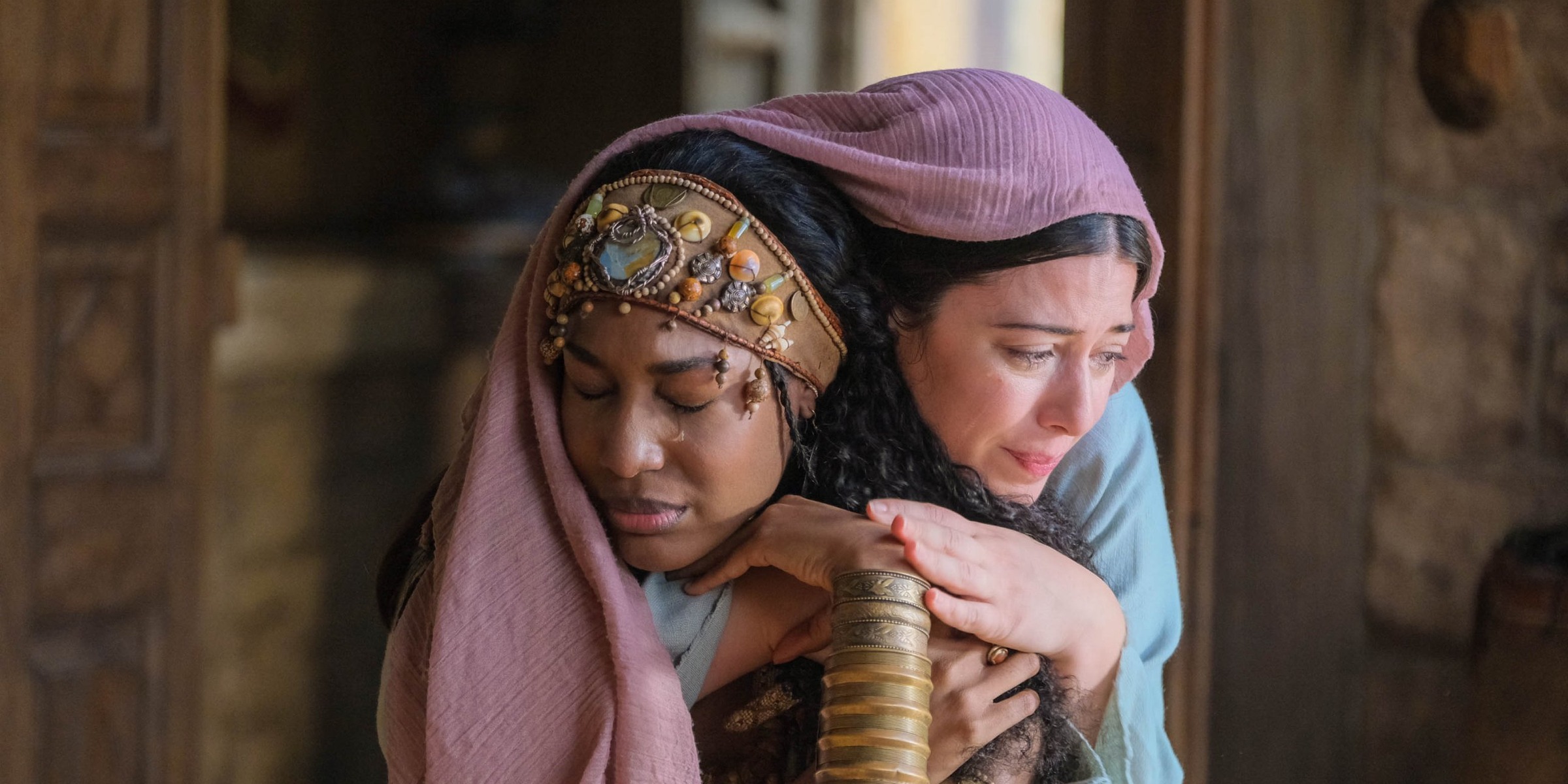
Mary Magdalene and Tamar’s conversation stole my heart.
We have watched as the relationship between Mary Magdalene and Tamar has become more and more strained. It was puzzling at times, and hard to watch. It was time for real talk. And in this episode, we got to experience it.
Tamar, just being her bold and confident self, caused the wise but insecure Mary to bristle.
The conversation started with Tamar’s simple question. “Are we ok?” I loved that Tamar didn’t ask Mary, “Are YOU ok?” Mary’s response was to point out Tamar’s behavior at the olive tasting. “I thought you were rude to Zebedee.” Tamar responded with politeness and directness. “I didn’t mean to be, but I thought he was asking our opinion.”
Mary, with attitude: “Well you gave it.”
Tamar knew this was not the root of their issues, so she asked “What else?”
And they quickly get to the heart of it, with Tamar’s courage to go there assertively and respectfully.
Mary admitted her jealousy that Tamar’s extreme boldness on the rooftop, with her paralyzed friend, got the response from Jesus, “Your faith is beautiful.” Mary felt ashamed of where Jesus found her and admitted that she tries so hard to live up to it and not fail again.
Tamar realized that Mary can’t see her depth of beauty, wisdom and belovedness. She is sad that Mary is holding on to shame.
Tamar said “You’re amazing! Can’t you see it?” Mary responded “I don’t think we’re supposed to see it!” and “I think we’re supposed to be more humble,” and she said a lot more…
Hurt people don’t mean to, but they so often project their hurt onto others, and become a source of more hurt.
Mary felt “behind” the guys, in learning. Her culture and religion placed restrictions on her gender, even though Jesus didn’t. Her life circumstances added to these situations and all contributed to lenses which skewed her vision. Her defense and coping mechanism became having an answer for everything, and being “perfect” in a new role that she was not yet comfortable with, and didn’t feel worthy of.
Tamar’s background is royal. She has confidence and intelligence, business experience, privilege and beauty. She is adorned with stunning jewelry, that she doesn’t want to sell for “oats” for the common good. When seen through Mary’s lenses, it’s so easy to see entitlement, brashness and selfishness. It’s the easiest thing in the world to judge motive and character from outside appearances. We all do it.
Tamar didn’t have the same lenses and could see Mary’s shame and regret, and even her own “entitlement” that she was a Jew who had gone through so much pain and oppression.
Thank goodness Tamar knew it was story time. Made me think of Melech in S2, when Jesus asked for his story in the presence of the Samaritan-hating disciples, and it changed everything. Jesus said, “This is what we do. We tell stories and listen to stories, and they connect us.”
As Tamar opens up, an intimate plucked melody flows in as she takes off her necklace, holds it up and asks Mary, “What do you see?” Mary doesn’t see at first. The plucking ceases, leaving a steady God note, that feels like it is bathing both women in grace and insight. Tamar’s story takes Mary out of her own head, and as she points to the center bead, she asks again, passionately, “What do you see?” Mary sees what is before her. “Is that dried blood?” Mary’s heart is so open to the vulnerability, pain and loss as Tamar tells her story, as the music so tenderly floats around them. Mary’s heart breaks for Tamar, and it changes everything. Mary sees her! And Ruby’s spirit voice seems to usher in a beautiful connection.
Mary’s former lens was smashed, at least for a time. Then Mary told her own story. These sisters connected, bonded, and forgave in a way that could not have happened without their vulnerability and the sharing of their stories. Tamar admits, “I should have told you sooner.”
This scene is so important. To help us to look inward, outward and upward. But also for us to consider our lenses.
Mary fought against her “street smarts” of her past and tried to make herself fit into the mold of the humble, simple and wise Jewish woman. She looked at Tamar through a lens of scarcity and conformity, jealousy and fear.
Mary said it perfectly. “I judged your strength against my weakness.”
We all have lenses of culture and upbringing, gender and personality. But the one I can’t unsee is our lens of faith tradition or religion.
The authentic Jesus is central to The Chosen story. Therefore, the audience includes every faith tradition which acknowledges Jesus. We all come to this show and watch it through our lenses. And we read the Bible through our lenses, one of the reasons so many believers can’t agree on interpretation of scripture.
But in The Chosen, we have—well written, God inspired backstory that I believe God knows we need. The story takes us out from behind our lenses. Helps us step back from what we have been taught. We get the opportunity to get out of our own heads and into someone else’s. Then with an open mind and softened heart, we see how Jesus responds to such a variety of people with all of their skewed lenses, and how they respond to Him. What a beautiful thing, that actually can help us to become more empathetic and discerning.
This scene also made me realize why in art and life, people who aren’t looking through a religious lens can see things that we can’t. Sometimes their lyrics or film feels more authentic.
Or a non-religious person can see something that feels more God breathed, just because they can see reality without the same lens that may have clouded our vision.
In this scene, Tamar could see so quickly that Mary was holding on to shame and could not accept the forgiveness that Jesus so freely gave her. And she could speak to that in the most honest way. And to Mary’s credit, she heard it. It was a breakthrough moment. A beautiful thing to witness. Sometimes, Mary wanted to judge Tamar’s lack of religious background. But thankfully Tamar didn’t let that push her away.
The Chosen is art. But also a tool. It can help us to love and follow Jesus. And can help us to be more aware of our lenses and learn to see each other as brothers and sisters, uniquely created in the image of God and loved by God. Oh May it inspire us to listen to each other and tell more stories.
Loved the way this one story ended, with joy and laughter and teamwork that was something to behold.
Here’s to: -Dallas Jenkins, Ryan Swanson, & Tyler Thompson’s masterful storytelling. -To Amber Shana Williams and Liz Tabish’s magnificent acting. -To Matt Nelson, Dan Haseltine, Steven Williamson and Ruby Amanfu, for the soundtrack of our characters’ lives, and for the beauty and wonder their melodies add to these stories -To new lenses -To His all sufficient grace in the story that inspires all good story.